



Scaling Generative AI in Enterprises
Generative AI has reached a significant development. It is now seen as an operational ability that affects productivity, operating cost structures, risk exposure, and competitiveness in 2025-2026, not as an experiment in innovation. For U.S. enterprise leaders, the question is no longer, “Should we use GenAI?” but: how do we scale GenAI in a way that delivers measurable business value while managing enterprise risk?
Who should pay attention: This discussion is particularly relevant for CIOs, CTOs, COOs, Chief Digital Officers, and enterprise transformation leaders responsible for operational efficiency, technology strategy, and risk oversight.
This blog explores GenAI from a senior executive perspective, emphasizing governance, investment prioritization, operational leverage, and financial impact.
Redolent, Inc. is a leading company providing Digital Transformation and Automation Engineering solutions, including but not limited to cloud engineering services and application development services. Let’s explore its foundational features and the impactful ways it facilitates change in the real world.
1. GenAI adoption has reached enterprise scale
The use of AI in enterprises has rapidly increased:
- According to McKinsey & Company research, 78% of organizations report using AI in at least one business function. The fields that use AI the most are product development, marketing, IT, and service operations.
- According to Gartner, task-specific AI agents are projected to be integrated into 40% of enterprise applications by 2026, marking a significant move away from experimental use and toward embedded intelligence in business systems.
- According to Deloitte research, worker access to AI tools increased significantly, signaling operational integration beyond pilot programs.
The executive conclusion is that, like cloud or cybersecurity investments, AI is integrating into enterprise infrastructure.
2. Financial impact: where ROI is being seen by leaders
As AI becomes embedded in enterprise software, organizations that move slowly will operate at a structural cost disadvantage and struggle to match the speed of AI-enabled competitors.
Industry studies indicate AI-enabled process automation can improve productivity by 20–40% in knowledge-heavy workflows, while AI-assisted customer operations often reduce handling time and service costs. Organizations applying AI in sales and marketing also report faster proposal cycles and improved engagement efficiency.
- Leverage productivity:
Documentation, evaluation, reporting, and internal communication all take less time because of GenAI. Even small improvements in efficiency add up to significant increases in labor productivity when multiplied by thousands of workers. This is considered by leaders as scalable operational leverage without corresponding increases in headcount.
- Optimization of operating costs:
Internal workflows, lengthy processes, and customer support interactions can all be automated to reduce laborious tasks and speed up processing cycles. This increases service consistency and speed while reducing the cost per transaction.
- Enabling revenue:
GenAI is used by sales and marketing teams to speed up customer research, proposal creation, and customized outreach. Higher pipeline speed and conversion potential can be achieved by quicker response times and higher-quality engagement.
3. The strategic risk of inaction
Enterprises that delay implementing structured GenAI risk growing competitive gaps. Operating models without AI support will have slower execution cycles and higher cost structures as AI becomes more deeply embedded into enterprise software and workflows. This can result in lower innovation velocity and lost market share in industries that move quickly.
Who should pay attention: This discussion is particularly relevant for CIOs, CTOs, COOs, Chief Digital Officers, and enterprise transformation leaders responsible for operational efficiency, technology strategy, and risk oversight.
4. Why launching pilots is easier than scaling GenAI
In regulated environments, early pilots often succeed, but enterprise scale adds complexity. Progress is slowed by outdated infrastructure, dispersed data sources, and unclear ownership models. Organizations find it difficult to maintain performance consistency, security, and reliability in their lack of robust operational frameworks.
5. Data readiness: the key to success
The dependability of GenAI output is determined by the enterprise data’s quality, governance, and accessibility. Stakeholder trust is damaged by inaccurate or biased outputs resulting from poor data history or inconsistent sources. Leaders are realizing more and more that disciplined data management techniques are crucial for the success of AI.
Organizations often work with engineering-led digital transformation partners to modernize data foundations, establish governance controls, and integrate AI into enterprise systems in a scalable and secure way.
6. AI risks are now a leadership responsibility
Risks associated with AI now merge with cybersecurity and regulatory exposure. Bias, delusions, and improper use of data can have negative effects on operations, reputation, and the law. Responsible AI moves from theory into risk mitigation through the use of human oversight, monitoring, and policy enforcement.
7. Enterprise GenAI strategic investment priorities
Funding for GenAI needs to stick to a strict order that preserves stability and creates value. To support scalable, secure AI tasks, leaders must first strengthen data infrastructure. Then, they must put governance frameworks in place to control risk and compliance. High-ROI workflow automation and a clear AI operating model that ensures cross-functional ownership and accountability should then be the focus of investment.
- Scalable, current information environments
- Structures for risk control and governance
- Use cases with high impact and measurable outcomes
8. Significant Executive Metrics
Instead of using technical metrics to evaluate GenAI success, C-suite executives use business performance indicators. Along with risk management and workforce adoption, focus areas include cost effectiveness, productivity increases, and revenue impact. These metrics ensure that AI initiatives are closely linked to operational performance and financial results.
- Decrease in the cost of each transaction
- Workforce productivity and time savings
- Impact on revenue and adoption rates
9. Workforce impact and organizational change
Adoption of GenAI impacts employee workflows compared to completely replacing jobs. To optimize the benefits of augmentation, upskilling, change management, and effective communication are essential. Stronger adoption and quicker returns are experienced by organizations that facilitate workforce transition.
10. The business environment in 2026
It is expected that AI support will be integrated into regular business tools by 2026. Data quality will become an asset in the marketplace, and governance processes will improve. Companies will outperform their competitors in terms of efficiency and customer responsiveness if they integrate innovation with strict oversight.
AI maturity will increasingly distinguish operational leaders from laggards, as organizations with embedded AI gain structural advantages in speed, cost efficiency, and decision quality.
Conclusion:
GenAI is an enterprise transformation tool, not a stand-alone technology initiative. Achieving a sustainable advantage will require finding a balance between operational discipline, governance maturity, measurable results, and innovation speed.
Enterprises looking to move from experimentation to scalable impact often begin with a structured AI readiness and infrastructure assessment to identify gaps in data, governance, and operational models.
At Redolent, Inc., we are passionate about providing comprehensive solutions that deliver measurable value and impact, aligning with the ever-changing demands of your business. Our dedicated team offers exceptional support and assistance, ensuring excellence and accelerating your success. Talk to us today to know more about our Digital Transformation and Automation Engineering solutions, including but not limited to cloud engineering services and application development services.
Reach out to us today at https://redolentech.com/reach-out-to-us/ to learn more about how we can help you achieve your goals.
Beyond AI Pilots: Why Enterprise AI Needs Infrastructure
August 3, 2026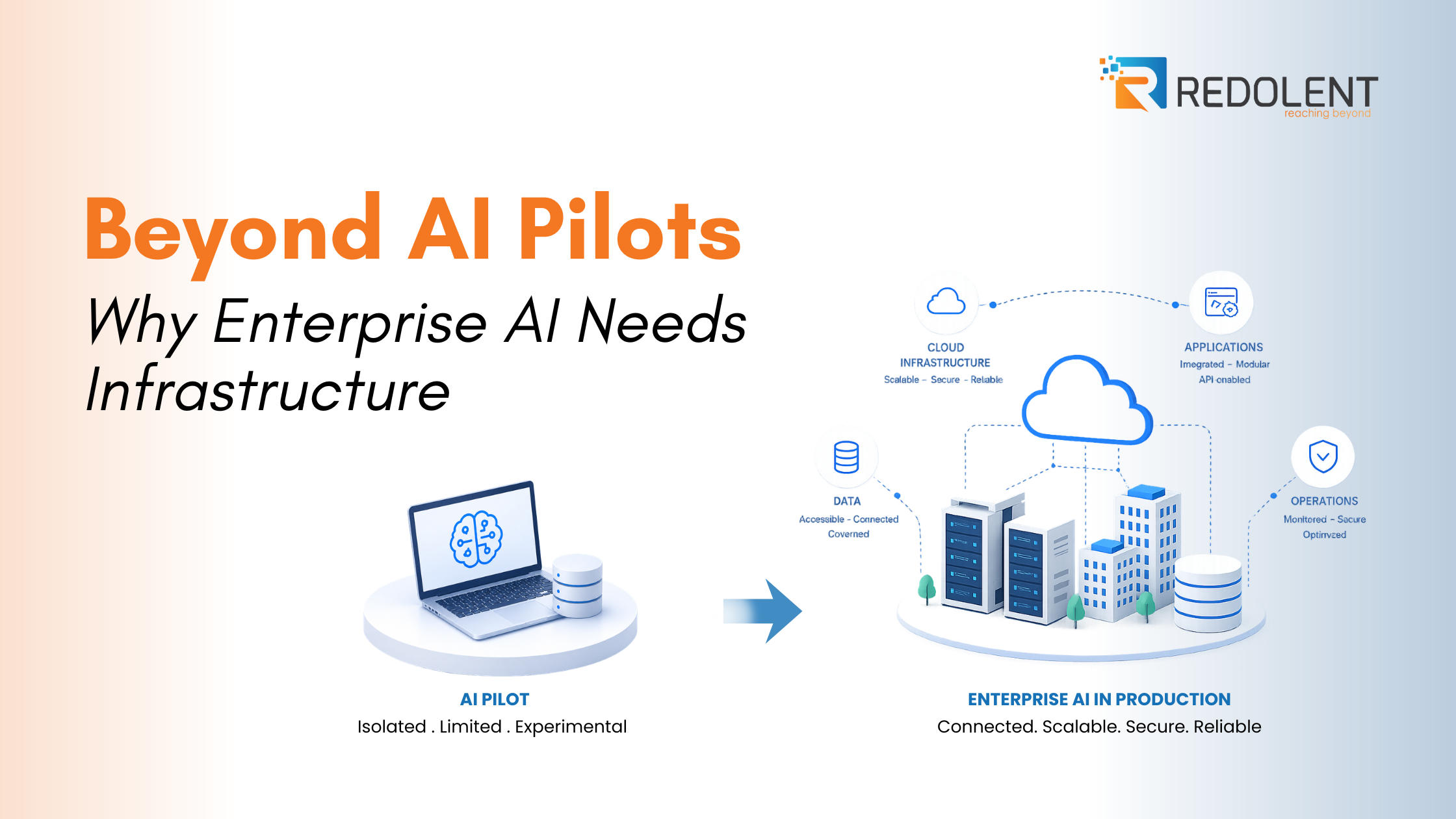
The Cost of Legacy Systems: Impact on Business Growth
April 9, 2026