



3 Game-Changers: GenAI in Hiring & Workforce Strategy
In 2025, generative AI is fundamentally transforming the way organizations handle hiring and workforce strategy. This revolutionary technology affects every aspect of talent acquisition and management, bringing unprecedented efficiency, accuracy, and strategic insight.
Redolent, Inc is a leading company providing various talent management solutions, including but not limited to contingent workforce services, managed workforce services, talent acquisition services and demand-driven screening services. Let‘s discuss three revolutionary effects of generative AI in hiring and workforce strategy that HR leaders and organizations simply cannot afford to miss.
1. Using AI-powered insights to change skills-based hiring
Generative AI has expedited the move away from traditional-based recruitment to skills-based hiring of applicants on the basis of proven ability, not simply qualifications. Employers increasingly use AI applications to review resumes, portfolios, and actual work projects, isolating key skills applicable to the position.
As of 2025, more than 90% of talent acquisition professionals agree that correct skills evalution in order to enhance quality of hire. Organizations using this AI-based strategy are 12% more likely to achieve a quality hire than their counterparts using traditional strategies. Generative AI can analyze huge amounts of candidate data automatically, learn the relevant skills, eliminate bias, and match talent more accurately to job specifications.
This skills-first strategy bridges the talent gaps in rapidly emerging industries, particularly those requiring advanced AI and technology skills. It also gives recruiters the ability to favor candidates who come with real value and experience-based skills over book knowledge.
2. Enhancing recruitment efficiency through generative AI automation
The application of generative AI agents has increased significantly in recruitment. Generative AI agents are autonomous systems that manage time-consuming tasks such as writing job descriptions, searching for candidates, scheduling interviews, and even initial candidate screening. Platforms like Workday’s recruiter agent, for example, harness large language models (LLMs) together with traditional software to automate the recruiting process.
This automation allows recruiters to regain precious time, enabling them to devote more attention to strategic talent choices and individualized candidate experiences. In reality, 35% of recruiters say they apply AI time gains mainly for candidate screening, and 26% allocate saved time to skills evaluation tasks, which most directly affect the quality of hiring.
Though AI speeds up the process, human judgment is still crucial, particularly in cultural fit assessment and final decision-making. Generative AI is more of a robust augmentation tool than a complete replacement, where strategy, empathy, and human connection are now more important in recruitment.
3. Transforming workforce planning with predictive analytics
In addition to recruiting, generative AI is also powering workforce strategy with higher-level predictive analytics that predict skill gaps, project employment demand, and guide quick talent deployment. This feature enables organizations to more efficiently manage risks due to employee turnover, maximize recruiting efforts, and align workforce capabilities with changing business objectives.
AI-powered platforms are able to project several hiring situations and skill pipeline requirements, allowing for forward hiring of critical skills ahead of shortages affecting the operations. Forward thinking is essential in a world where technology and market demand change at a rapid pace, requiring continuous reskilling and workforce flexibility.
Furthermore, generative AI supports automated onboarding and training, making the transition for new hires smoother via personalized digital experiences and compliance automation, improving retention and engagement from the start.
Additional insights on Generative AI’s hiring impact in 2025
- Shifts in the Job Market: Generative AI technology has taken away jobs in writing, coding, and design, decreasing some conventional occupations by approximately 20-30% but developing new AI and data jobs at a fast pace.
- Blended Workforce Models: Organizations are embracing hybrid models with combinations of human and AI agents to maximize talent management and operational effectiveness.
- Gender Gap Awareness: There is an acknowledged requirement to bridge the generative AI use gap between women and men in workplaces so that technology benefits reach both on a level field.
This blog shares the latest research and trends to help HR professionals and business leaders use Generative AI in hiring and workforce planning in 2025. By using AI tools, companies can improve talent quality, speed up hiring, and plan for the future more effectively. We also cover how to build a strong workforce strategy in 2025, using AI to stay ahead in a fast-changing world of work.
Talk to us today to know more about our talent management solutions, including but not limited to contingent workforce services, managed workforce services, talent acquisition services, and demand-driven screening services. Reach out to us today at:https://redolentech.com/reach-out-to-us/
Beyond AI Pilots: Why Enterprise AI Needs Infrastructure
August 3, 2026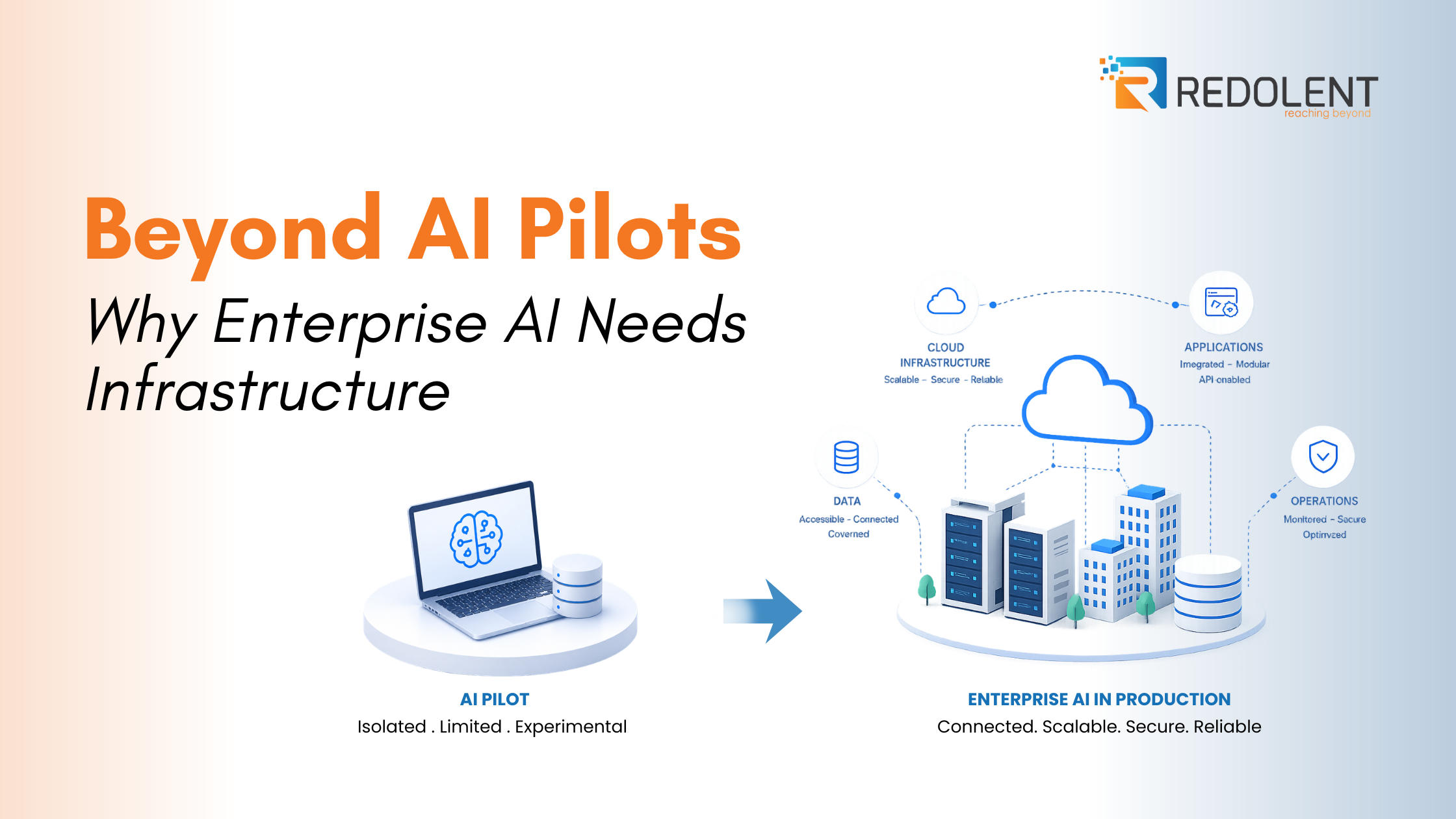
The Cost of Legacy Systems: Impact on Business Growth
April 9, 2026