



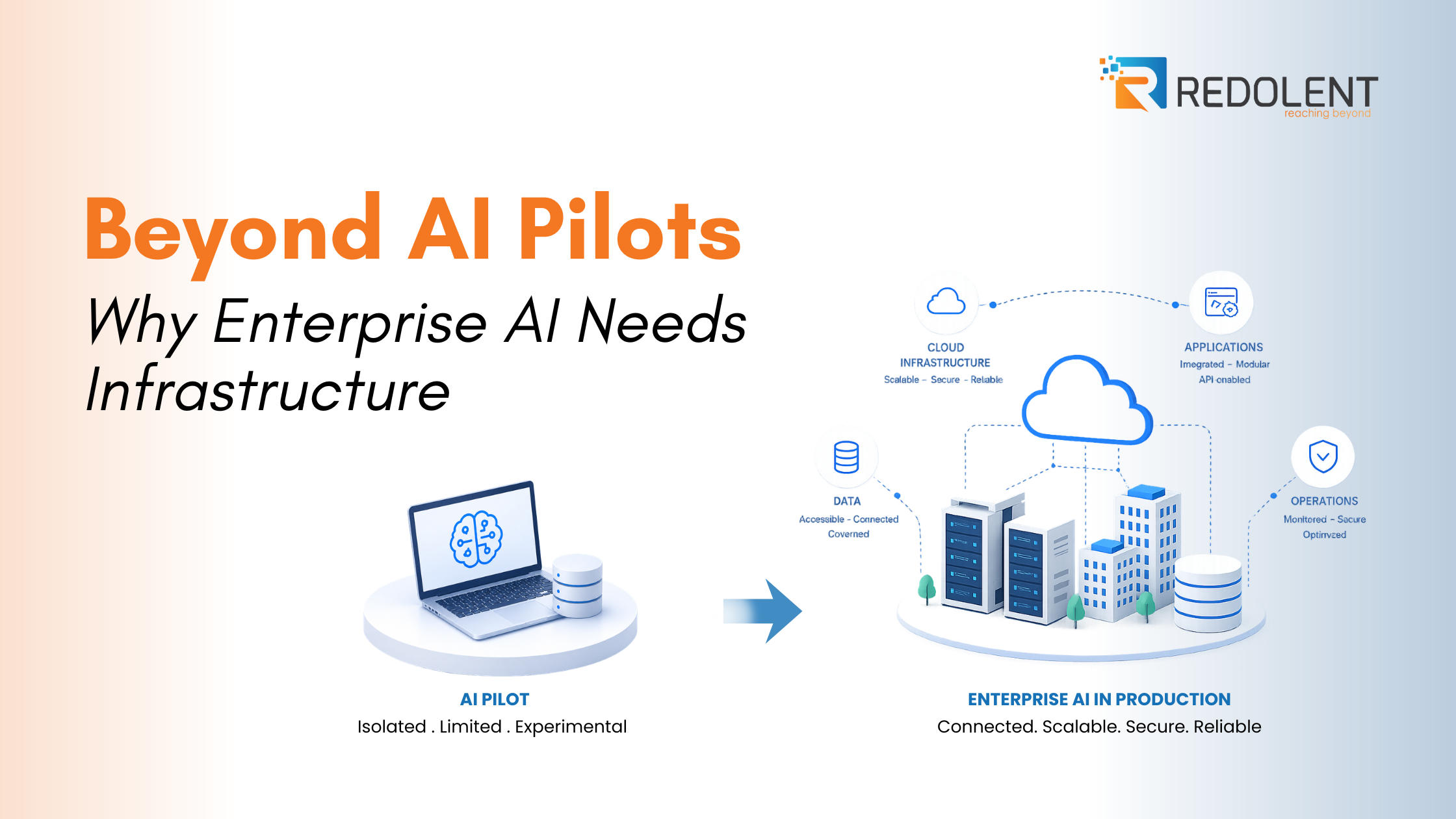
Beyond AI Pilots: Why Enterprise AI Needs Infrastructure
The Death of AI Pilots: Why Enterprise AI Needs Infrastructure, Not More Models
Enterprise AI has spent the last few years in experimentation mode. Organizations have tested generative AI across customer support, software development, document processing, knowledge search, workflow automation, and other business functions. Many of these pilots have delivered promising results. However, moving from a successful experiment to a dependable business capability requires more than a capable model. Enterprise AI infrastructure is becoming a critical part of that transition, particularly as AI applications begin connecting with existing systems, business data, and production environments.
The harder part begins after the pilot succeeds.
Moving an AI solution into everyday business use means connecting it with existing applications, giving it access to the right data, supporting more users, managing security requirements, and maintaining reliable performance. These challenges are very different from evaluating whether a model can perform a particular task.
This is creating an important shift in enterprise AI strategy. The question is moving from “Which model should we use?” to “Is our technology environment ready to support AI in production?”
Model capabilities will continue to improve, and access to leading AI technologies will become increasingly common. The larger difference between organizations will be their ability to integrate those technologies into the systems that already run the business. Cloud infrastructure, application architecture, data access, integration, monitoring, and day-to-day operations are becoming just as important as the model itself.
The gap between an AI Pilot and Production
AI pilots are intentionally designed to reduce complexity. They usually focus on a specific problem, involve a limited number of users, use carefully selected data, and receive close support from the team responsible for the project. This makes it possible to test an idea quickly without making major changes to the broader technology environment.
Production introduces conditions that are difficult to reproduce during a pilot. An AI assistant tested by one department may eventually need to serve thousands of employees. Instead of using a small collection of documents, it may need information from databases, cloud storage, business applications, and internal knowledge systems. Access must reflect user permissions, information needs to remain current, and performance must remain consistent as demand changes.
As AI moves into production, organizations commonly encounter challenges such as:
- Data spread across disconnected systems and applications
- Older applications that are difficult to integrate
- Infrastructure that was sized for predictable workloads
- Increasing compute and operating costs as usage grows
- Limited visibility when performance problems occur
- More complex security, access, and governance requirements
A successful pilot proves that an AI use case has potential. It does not necessarily prove that the organization has the technology foundation required to support that use case across the business.
AI is exposing technology problems that already existed
Many of the barriers slowing enterprise AI are not new. Fragmented data, legacy applications, difficult integrations, and manual infrastructure processes have existed for years. AI makes these limitations more visible because an AI application often needs to work across several systems at once.
Consider enterprise data. Customer information may be stored in a CRM platform, financial information in an ERP system, operational data in databases, and business knowledge across documents and collaboration platforms. Employees have learned to navigate these systems individually, but an AI application needs a reliable way to access and use information across them.
A stronger model cannot solve a data access problem. If an AI assistant can access only part of an organization’s information, changing the model may improve how an answer is written without improving the information behind it. This is why many AI projects eventually become integration and data engineering projects.
Existing applications create a similar constraint. Many critical enterprise systems were designed long before AI integration became a priority. Limited APIs, tightly connected components, and custom interfaces can make adding new capabilities difficult and expensive.
Application modernization therefore has a direct role in AI readiness. This does not mean replacing every legacy application. The more practical objective is to make important business systems easier to connect through APIs, modular application design, and modern integration approaches. Doing so creates a foundation that can support not only today’s AI use cases but also technologies that emerge later.
Why Enterprise AI infrastructure is becoming part of the AI strategy
Enterprise infrastructure has traditionally been evaluated through availability, performance, security, capacity, and cost. AI adds new demands to each of these areas.
Usage can increase quickly after a successful deployment. AI applications may depend on several internal and external services, while compute requirements can vary significantly depending on the task. Large volumes of data may need to move between systems, and a failure in one dependency can affect the entire user experience.
As a result, cloud and infrastructure decisions need to be considered much earlier in the AI lifecycle.
Four capabilities are particularly important:
1. Infrastructure that can adapt to demand
AI usage rarely grows in a predictable way. A service may begin with a small user group and expand quickly once employees see value in it. Infrastructure needs to accommodate these changes without creating performance problems or excessive costs.
Scalability alone is not enough. Organizations also need visibility into how resources are being consumed so they can balance performance with cost as adoption grows.
2. Applications and data that are easier to connect
AI becomes more useful when it can work with the systems where business activity already happens. A customer service application may need CRM and order information, while an engineering assistant may rely on technical documentation, source code, and project systems.
If every connection requires a new custom integration, expanding AI becomes slow and expensive. Reusable APIs and integration services make it easier to connect new AI capabilities without rebuilding the same connections for every project.
3. Visibility across the environment
When an AI application becomes slow or unavailable, the problem may originate in the application, infrastructure, network, database, model service, or an integration with another system.
Technology teams need visibility across these dependencies to understand where failures occur, how resources are being used, and whether performance is changing over time. This becomes increasingly important as AI moves into business processes where downtime has a direct operational impact.
4. Operations that don’t depend on constant manual work
AI applications will continue to change as models improve, data sources evolve, and business requirements expand. Managing every infrastructure change manually becomes difficult as the number of AI services increases.
Automation can simplify provisioning, deployment, monitoring, and routine infrastructure tasks. Consistent managed infrastructure practices can also help maintain reliability once AI applications become ongoing business services rather than temporary experiments.
From individual AI projects to a reusable foundation
Early enterprise AI initiatives have largely been developed as individual projects. A team identifies a use case, selects a model, develops an application, and creates the infrastructure needed to support it.
That approach works during experimentation, but it becomes inefficient as AI adoption expands.
If every new project requires its own integrations, infrastructure setup, monitoring, security controls, and deployment processes, organizations repeatedly solve the same engineering problems. Costs increase, delivery slows, and the overall environment becomes harder to manage.
A more sustainable approach is to create reusable capabilities that support multiple AI initiatives. Common approaches to data access, integration, deployment, monitoring, security, and infrastructure management allow new applications to build on an existing foundation.
This does not mean standardizing every AI project on one model or platform. AI technology is changing too quickly for that. The stronger approach is to build flexibility into the technology environment so models can change, new applications can be introduced, and workloads can evolve without requiring the underlying infrastructure to be redesigned each time.
What should technology leaders measure next?
Model accuracy and response quality remain important, but they are not enough to measure whether enterprise AI is becoming sustainable.
Technology leaders should also consider questions such as:
- How quickly can an AI use case move from pilot to production?
- How much engineering work is required to connect it with existing systems?
- Can infrastructure handle increased usage without constant manual intervention?
- How quickly can teams identify and resolve performance issues?
- What happens to operating costs as adoption increases?
- Can infrastructure and integration work be reused across future AI projects?
These measures provide a clearer picture of whether an organization is developing a repeatable AI capability or simply producing more experiments.
The next AI advantage will come from execution
Powerful AI models are becoming widely available. The real difference will be how well businesses can use them in day-to-day operations.
Companies with the right cloud infrastructure, connected applications, accessible data, and reliable systems can move AI projects into production more easily. For technology leaders, the focus should now be on building a strong foundation that can support AI as business needs and technology continue to change.
At Redolent, Inc., we help enterprises strengthen that foundation through cloud engineering, application modernization, automation, and managed infrastructure services. Whether you’re preparing for your first production AI use case or looking to scale existing initiatives, the right technology foundation can make the transition easier to manage.
Beyond AI Pilots: Why Enterprise AI Needs Infrastructure
August 3, 2026