


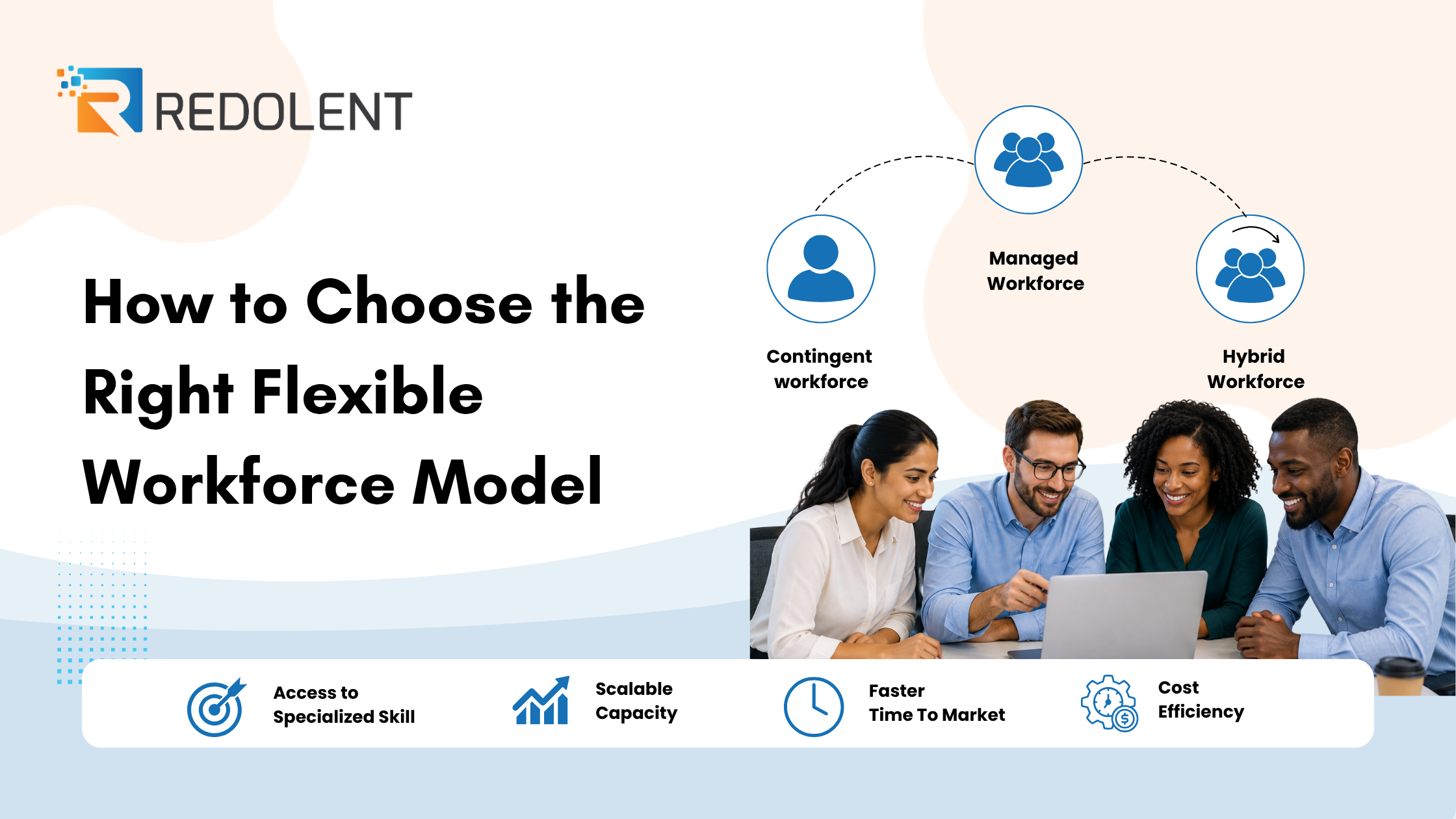
How to Choose the Right Flexible Workforce Model
Technology leaders often need to adjust their teams as project requirements change. A flexible workforce model gives enterprises more options when they need additional engineering capacity, specialized skills, or temporary project support. For example, a cloud migration might require more cloud engineers, while an AI project might require specialists who are not available within the existing team.
For CTOs, CIOs, and IT leaders, these requirements make workforce planning part of technology delivery. You need to decide which skills should stay in house, where external professionals fit, and how your team should change as project needs develop.
A flexible workforce model allows internal teams to retain core responsibilities while contingent professionals, managed teams, or external specialists provide additional skills and capacity when needed.
Why flexible workforce models matter to technology leaders
Technology projects often need different skills at different stages. A cloud migration might require a larger engineering team during implementation and a smaller team after the main migration work is complete. An application modernization project might need more developers during development and more testing resources before release.
Technology skills are also changing quickly. The World Economic Forum’s Future of Jobs Report 2025 found that 39% of workers’ existing skill sets are expected to change or become outdated between 2025 and 2030. The report also found that 63% of employers identify skill gaps as a major barrier to business transformation. AI and big data, networks and cybersecurity, and technological literacy are among the fastest growing skills.
For a CTO or CIO, workforce planning involves more than increasing headcount. You need to decide which capabilities your organization should build internally, where external expertise makes sense, and how to adjust team capacity as project requirements change.
A flexible workforce approach gives technology leaders more ways to address these needs. It allows you to build a team around the work instead of using the same workforce structure for every technology project.
What is a flexible workforce model?
A flexible workforce model allows an enterprise to adjust its workforce based on business and technology requirements. Your organization can use permanent employees for core engineering, architecture, product, and leadership responsibilities while bringing in external professionals for specific project needs.
Three common approaches to a flexible workforce model are contingent workforce services, managed workforce services, and hybrid workforce models.
A contingent workforce gives your team access to individual professionals for defined skills or periods. A managed workforce provides a broader team structure for projects that need several skills and additional support. A hybrid workforce combines internal employees with external professionals or teams.
Each model serves a different requirement. The decision should start with the technology work you need to deliver.
When a contingent workforce makes sense
A contingent workforce suits technology projects with defined skill requirements, temporary increases in engineering capacity, or changing workloads. Your team might need additional software engineers during a major release, cloud specialists during a migration, or cybersecurity professionals for a specific security program. Bringing in external professionals for a defined requirement gives your organization more flexibility as project needs change.
Recent U.S. staffing data also points to continued demand for temporary and contract talent. According to the American Staffing Association’s July 2026 Staffing Index, staffing jobs during the week of July 13 to 19 were 3.7% higher than during the same period in 2025. The report also found that temporary and contract staffing employment for the four weeks ending July 19 was 5.2% higher than during the same period in 2025.
For technology leaders, these figures provide recent U.S. market context for flexible workforce models. Contingent talent gives enterprises access to specialized skills and additional engineering capacity when project requirements increase, while internal teams continue to manage core technology responsibilities.
A Contingent Workforce fits well when your enterprise needs:
- Access to a specialized technology skill for a defined project period
- Additional engineering capacity during high demand project phases
- External expertise for skills not available within your internal team
- Temporary workforce support when project workloads increase
- Greater workforce flexibility as technology project requirements changes
Contingent professionals typically work within your existing team structure. Your engineering managers guide the work, while the external professionals provide the additional skills and capacity required for the project.
When a managed workforce makes sense
A managed workforce suits projects where your organization needs a team rather than a few individual professionals. Large technology programs often require several skills, coordinated delivery, and clear responsibilities across the team.
Consider an application development program. The project might require software developers, quality engineers, technical specialists, and program support. Managing every external professional separately adds work for internal technology leaders.
A managed workforce provides a different structure. An external workforce partner supports staffing and team organization based on the agreed project requirements. Your organization defines the business need and expected outcomes, while the workforce partner provides the team structure and project support.
At Redolent, we help enterprises build flexible technology teams based on their project needs. Our Talent Solutions include contingent and managed workforce services, with on site, off site, and nearshore team options.
A Managed Workforce Fits Well When You Need:
- A larger team with multiple technology skills
- Support for a defined technology initiative
- Coordination across several technical roles
- Additional support with workforce management
- A team structure built around specific project requirements
With a managed workforce, internal technology leaders have more time to focus on architecture, product priorities, business decisions, and other areas where their direct involvement matters.
When a hybrid workforce makes sense
A hybrid workforce combines internal employees with external professionals or teams. This structure suits enterprises where internal teams need additional engineering capacity while retaining ownership of important technology and business decisions.
For example, your internal team might own product requirements, architecture, technical direction, and business decisions. External software developers, cloud engineers, data specialists, or quality engineers might support development and implementation.
This approach works well when you already have a strong internal team but need additional people or specialized skills for a specific initiative. External resources add capacity without requiring your organization to rebuild the entire engineering structure.
A hybrid workforce also supports different delivery locations. Your internal U.S. team might work with on site, off site, or nearshore resources depending on project requirements. At Redolent, our Managed Workforce Services include on site, off site, and nearshore team models based on project requirements.
A Hybrid Workforce Fits Well When You Want To:
- Keep core technology ownership within your organization
- Add specialized external skills
- Increase engineering capacity for a project
- Combine internal and external teams
- Support work across different locations
A hybrid model needs clear responsibilities from the start. Internal and external teams should understand who owns decisions, who manages the work, how teams communicate, and how project results are measured.
How Contingent, Managed, and Hybrid Workforce models differ
These workforce models address different technology delivery needs. Contingent workforce services are useful when you need individual professionals for a defined skill or period. Managed workforce services suit projects that require a broader team structure and additional workforce support. Hybrid workforce models suit enterprises that want to combine internal knowledge with external skills and capacity.
An enterprise does not need to use one model for every project. A technology organization might use contingent professionals for a specialized role, a managed team for application development, and internal employees for architecture and product ownership.
The workforce model should follow the project requirement. Your team structure should reflect the work your technology organization needs to deliver.
How to choose the right flexible workforce model
Start with the project timeline. A temporary requirement for one or two specialists often suits contingent talent. A larger program involving several technical roles might suit a managed workforce. A long-term initiative with strong internal ownership might suit a hybrid model.
Next, review the skills required. Your internal team might have strong engineering capabilities and still need specialized expertise for AI, cybersecurity, data, cloud, or application modernization.
The World Economic Forum identifies AI and big data, networks and cybersecurity, and technological literacy as the three fastest growing skill areas through 2030. Technology related roles including big data specialists, AI and machine learning specialists, and software and application developers also rank among the fastest growing jobs.
Technology leaders also need to consider management responsibility. Contingent professionals generally work within the existing team structure. A managed workforce provides greater workforce and team support from the external provider. A hybrid model requires close coordination between internal and external teams.
Project demand is another important factor. Staffing needs often change between planning, development, testing, implementation, and ongoing support. A flexible workforce model should allow the team to adjust as the project moves through these stages.
Consider These Factors Before Choosing a Workforce Model:
- Project duration
- Number of technology professionals required
- Skills available within your internal team
- Specialized skills required for the project
- Level of management support required
- Expected changes in project demand
- Responsibilities that should remain internal
- On site, off site, or nearshore delivery requirements
These factors help technology leaders make workforce decisions based on project requirements instead of short term hiring pressure.
Workforce flexibility is more than a cost decision
Cost matters when technology leaders plan team structures but cost alone does not determine whether a workforce model will support successful delivery.
Your team also needs the right skills, sufficient engineering capacity, clear ownership, and a structure suited to the project. A lower staffing cost does not solve a skills gap or reduce the management work required from an already stretched engineering organization.
The World Economic Forum reports that 85% of surveyed employers plan to prioritize workforce upskilling through 2030, while 70% expect to hire staff with new skills. The same report says skill gaps are the biggest barrier to business transformation, with 63% of surveyed employers identifying them as a major barrier.
For enterprise technology teams, internal development and external talent serve different purposes. Your organization might develop skills needed for long term technology strategy while bringing in external professionals for projects with specific or changing requirements.
The focus should be on building the team structure needed to deliver the work and support the business goal.
How to build a flexible workforce strategy
Start by reviewing your existing technology workforce. Look at your engineering skills, current capacity, upcoming projects, and expected technology initiatives. This gives you a clearer view of where your internal team has sufficient capacity and where additional support is needed.
Next, separate long-term capabilities from project specific skills. Skills required across multiple projects might call for internal hiring, training, or development. Skills required for a defined cloud migration, implementation, or modernization project might suit contingent professionals or a managed team.
Then consider the required team structure. A project that needs one specialist has different workforce requirements from a program that needs developers, testers, cloud engineers, data specialists, and program support.
Your organization should also decide which responsibilities need internal ownership. Product strategy, business requirements, architecture, and major technology decisions often require close involvement from internal leaders. External professionals can provide skills and capacity around those responsibilities.
Once the workforce model is in place, review it as the project changes. The team structure required during development might differ from the structure needed during testing, implementation, or ongoing support.
A Practical Workforce Planning Process Includes:
- Reviewing your existing technology skills and team capacity
- Mapping upcoming projects and their workforce requirements
- Distinguishing long term roles from temporary project needs
- Assessing skill gaps within the internal team
- Choosing between contingent, managed, and hybrid workforce models
- Setting clear ownership for teams and project delivery
- Reassessing workforce needs as project requirements change
This approach keeps workforce planning closely tied to technology delivery. It also helps technology leaders make staffing decisions based on actual project requirements.
How Redolent supports flexible technology workforce needs
At Redolent, we help enterprises build flexible technology teams based on their project needs. Our Talent Solutions include contingent and managed workforce services, with on site, off site, and nearshore team options. These services help technology leaders add specialized skills, increase engineering capacity, and choose a workforce model that fits each project.
Choosing the right workforce model for your enterprise
There is no single workforce model for every technology project. A contingent workforce suits a defined skill or temporary capacity requirement. A managed workforce suits projects requiring a broader team and additional workforce support. A hybrid workforce suits enterprises that want to combine internal knowledge with external skills and capacity.
Your workforce decision should start with the technology work you need to deliver. Look at the skills required, project duration, engineering capacity, management needs, delivery location, and responsibilities your organization needs to keep internally.
A flexible workforce strategy gives CTOs and CIOs more options when technology requirements change. The right flexible workforce model depends on your technology goals, project timeline, technical skills, team capacity, delivery structure, and management requirements.
For enterprises working on cloud migration, application modernization, AI initiatives, data programs, cybersecurity projects, and other technology priorities, workforce flexibility provides another way to align talent with delivery requirements.
The focus should stay on building a technology team with the right skills, capacity, ownership, and structure for each stage of the project.
Beyond AI Pilots: Why Enterprise AI Needs Infrastructure
August 3, 2026
The Cost of Legacy Systems: Impact on Business Growth
April 9, 2026