





Top 5 Enterprise AI Adoption Pitfalls in 2026
Artificial intelligence (AI) continues to transform US business operations, from streamlining processes to enhancing customer experiences. Enterprise AI adoption is not without challenges, however, despite its potential. Due to avoidable errors, many companies struggle to fully leverage the benefits of AI.
This blog explores the top five challenges US businesses will face when implementing AI in 2026 and provides practical solutions. Business leaders can set up their companies for growth in the AI-driven landscape by taking recommendations from these common challenges.
Redolent, Inc. is a leading company providing Digital transformation solutions, including but not limited to cloud engineering services & application development services. Let’s explore its foundational features and the amazing ways it facilitates change in the real world.
1. Lack of goals and strategy
Many companies introduce projects related to AI without an organized strategy. Instead of setting measurable goals, they frequently adopt trends. AI initiatives may therefore stop working, provide little benefit, or even fail.
Why it happens
- Leadership could be under pressure to quickly implement AI.
- Teams might prioritize technology over business results.
How to stay away from it:
- Before beginning any AI project, establish specific, measurable goals.
- Determine which particular business issues AI can solve, such as enhancing supply chain efficiency or customer service response times.
- Align AI projects with the overall business plan.
Example:
A US retail chain made significant investments in AI for personalized marketing, but it failed to establish KPIs. Campaigns performed poorly as a result, and ROI was unclear. Setting clear goals could have prevented resource waste.
2. Ignoring governance and data quality
Data is essential for AI systems. Inaccurate forecasts and poor decision-making may arise from low-quality data, discrepancies, or missing information.
Why it occurs
- Businesses ignore the significance of structured and clean data.
- Accessing data can be challenging if it is located in separate departments.
How to stay away from it:
- Put into practice data governance processes such as access controls, standardization, and data cleaning.
- Ensure cooperation between business units, data teams, and IT.
- To ensure accuracy, audit and update datasets on a regular basis.
Example:
An American insurance provider used AI to automate claims. Incorrect data entry across regional offices caused the system to produce errors, which slowed processing times. Centralized data governance could have reduced these problems.
3. Ignoring change management
Adoption of AI changes how people work and is more than just an advance in technology. Employees who feel nervous or inexperienced may refuse new AI tools, putting plans on hold.
Why it occurs
- Businesses prioritize deploying AI while ignoring communication and training.
- Workers consider themselves cut off from fresh methods and are not involved in planning.
How to stay away from it:
- Clearly explain the objectives and advantages of AI to every team.
- Provide training courses to assist employees in adjusting.
- To encourage ownership, include employees in the planning of AI implementation.
Example:
A US financial services company used AI to create chatbots for customer service but failed to train call center employees. Adoption was delayed by a large number of staff members opposed to using the system. Training and initial engagement would have made the transition simpler.
4. Choosing the incorrect AI vendors or tools
Investment waste, integration problems, and technical challenges may occur from selecting the incorrect AI platform or vendor.
Why it occurs
- Businesses might be attracted to eye-catching AI solutions without considering whether they’re appropriate.
- Rather than business fit, vendor marketing could have an impact on decision-making.
How to stay away from it:
- Perform in-depth vendor research and ask for industry-relevant case studies.
- Pilot programs are used to test tools before full-scale deployment.
- Give top priority to platforms that work well with existing systems.
Example:
An AI-powered routing system that a US logistics company bought didn’t work with their outdated warehouse software. Delays and annoyance resulted from the mismatch. A thorough assessment would have avoided the expensive error.
5. Not measuring performance and ROI
If companies fail to track results, even effective AI implementations can fail. Decision-makers fail to evaluate impact or justify additional investment due to the lack of clear metrics.
Why it occurs
- Companies use AI, but they don’t specify performance metrics in advance.
- AI results might take some time to show up, which could cause impatience or poor decision-making.
How to stay away from it:
- Establish KPIs that represent business goals, such as improved customer satisfaction, decreased expenses, or increased efficiency.
- Evaluate AI performance on a regularly basis and make necessary strategy adjustments.
- Make insights available through using dashboards and reporting tools.
Example:
A US healthcare provider used AI to improve patient scheduling. The team was unable to measure improvements without monitoring patient satisfaction or wait times for appointments, which made it challenging to get additional AI funding.
Best practices for successful AI adoption
US companies ought to handle AI adoption with careful planning, attainable goals, and strong leadership commitment in order to maximize success. The following best practices ensure that initiatives involving AI provide measurable, important benefits.
- Create a well-defined AI strategy: A clear strategy that is related to business objectives is the basis of any successful AI initiative. Leaders should define success clearly rather than implementing AI because other companies are. This involves figuring out how AI can boost productivity, reduce expenses, or improve client experiences. Teams remain focused when AI projects are linked to measurable outcomes. Teams stay focused, and leadership can easily monitor progress and justify investment when AI projects are linked to quantifiable results.
- Prioritize data quality as the top priority: The accuracy of AI systems depends on the data they use. Due to incomplete, out-of-date, or dispersed data across departments, many US organizations face difficulties. Businesses should spend time organizing and cleaning their data before deploying AI. In order to ensure that AI tools generate reliable and accurate insights rather than false outcomes, strong data governance, clear ownership, and uniform standards for data are essential.
- Engage workers as soon as possible: Employee involvement is essential because the adoption of AI has an impact on how people work. Resistance decreases when employees understand the reasoning behind the introduction of AI and how it improves their roles. Throughout the process, companies should seek employee feedback, offer practical training, and clearly communicate benefits. This strategy builds trust and motivates teams to view AI as a useful tool rather than a threat.
- Carefully consider the tools: Not every company is a good fit for every AI solution. Businesses shouldn’t choose tools only based on marketing trends or claims. Leaders may instead focus on whether a solution is in line with their existing processes, systems, and future needs. Costly errors and implementation delays can be avoided by conducting pilot programs, asking for real-world case studies, and testing integrations.
- Monitor performance regularly: Like any other business investment, AI initiatives should be monitored. Leadership can better understand impact by establishing clear KPIs early on, such as time saved, lower expenses, or increased customer satisfaction. Instead of viewing AI as a one-time project, regular performance reviews allow teams to improve AI models, strategies, and results over time.
In addition, companies can more successfully navigate these best practices by working with seasoned AI consultants like Redolent Inc. Redolent Inc. helps companies develop AI strategies that are achievable, scalable, and in line with long-term objectives through a business-first approach and practical experience.
Conclusion:
In conclusion, 2026 presents both risks and opportunities related to enterprise AI adoptions. The most important lesson is that strategy, data, people, and execution are more important for success than technology. US companies can utilize AI to gain a significant competitive edge by avoiding common pitfalls and adhering to established best practices.
In general, companies have the greatest chance to achieve long-term success if they carefully plan and seek expert guidance. Companies can successfully navigate the AI journey with clarity, confidence, and measurable results when they work with trustworthy partners like Redolent Inc.
At Redolent, we are passionate about providing comprehensive solutions that deliver measurable value and impact, aligning with the ever-changing demands of your business. Our dedicated team offers exceptional support and assistance, ensuring excellence and accelerating your success. Talk to us today to know more about our Digital transformations solutions, including but not limited to cloud engineering services & application development services.
Reach out to us today at https://redolentech.com/reach-out-to-us/ to learn more about how we can help you achieve your goals.
Beyond AI Pilots: Why Enterprise AI Needs Infrastructure
August 3, 2026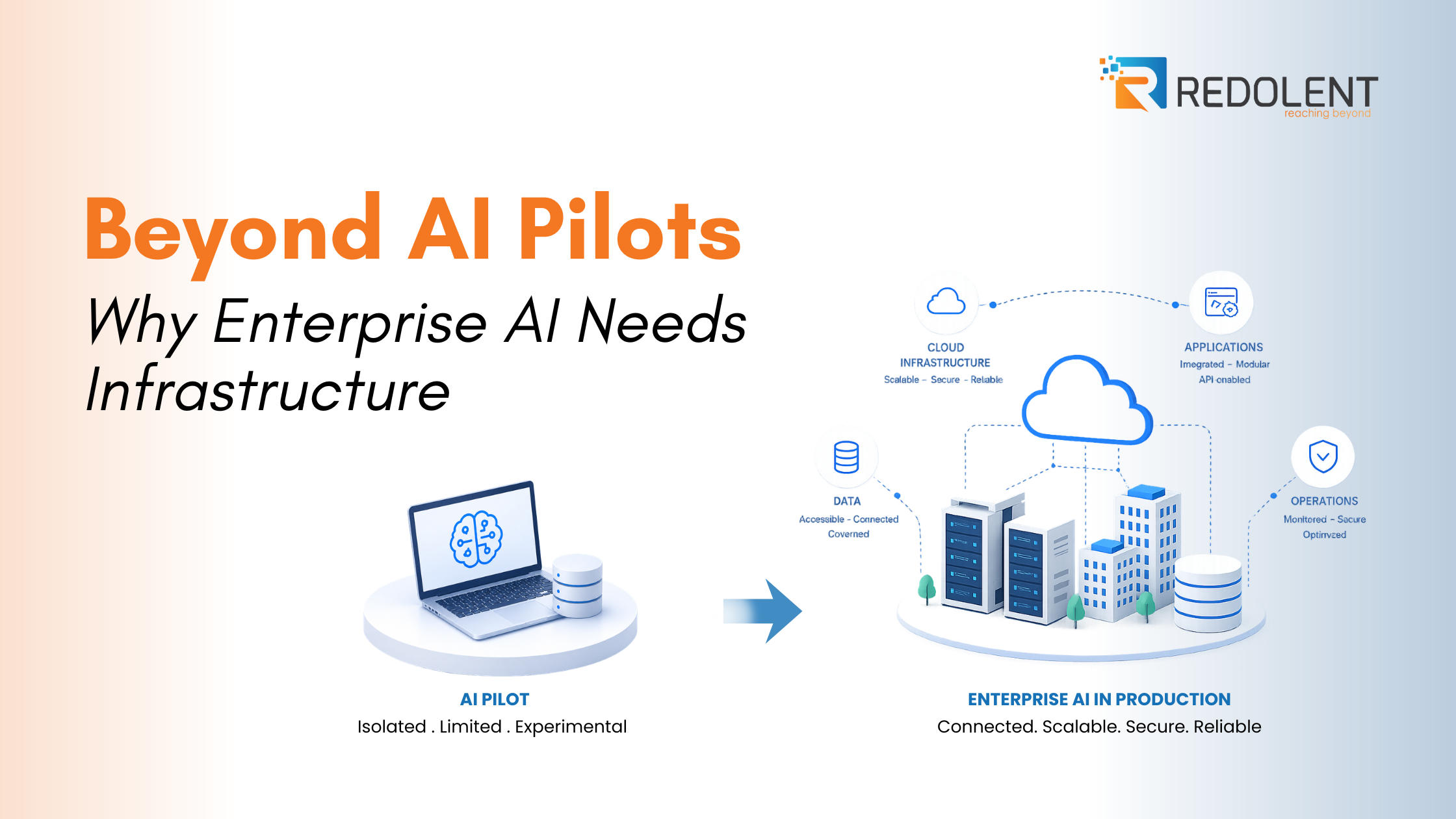

The Cost of Legacy Systems: Impact on Business Growth
April 9, 2026