



Edge Computing and Automation Drive Real-Time Performance
In the accelerated digital age of today, speed is more critical than ever. For American companies in industries such as manufacturing, logistics, telecom, and intelligent infrastructure, real-time processing is no longer luxury; it’s a requirement. Traditional cloud frameworks tend to be affected by latency, bandwidth, and network dependencies. Edge computing, combined with automation, on the other hand, enables organizations to process data near where it is created, unlocking ultra-low latency, increased reliability, and wiser decision-making.
Redolent, Inc is a leading company providing Managed Infrastructure Services including but not limited to Talent solutions, Cloud engineering service & Application development services.
What is Edge Computing and why does it matter?
Edge computing refers to a distributed computing model in which data analysis, storage, and processing take place near the source of data generation (i.e. “at the edge” of the network), and are not sent back and forth to a central cloud or data center. In reality, edge architecture can consist of:
- Edge devices (sensors, IoT modules, cameras)
- Edge gateways or mini servers
- Local analytics/ inference engines
- Hybrid connectivity to central cloud for aggregated insights
By processing as much locally as possible, edge systems minimize data travel, cut latency, and save bandwidth.
Why Edge matters to U.S. enterprises
While cloud computing transformed scale and flexibility, it has physical and network constraints: distance, bandwidth, and reliance on connectivity. For most U.S. companies with mission-critical, latency-sensitive use cases, those constraints become bottlenecks.
Additionally, regulatory, compliance, and data sovereignty issues sometimes necessitate sensitive data remaining within specific jurisdictions. Edge computing provides tighter control over where data gets processed and stored.
Finally, with IoT, 5G, and industry digitization on the rise, volumes of data are exploding. Shipping all raw data to the cloud is wasteful and expensive. Edge computing allows for filtering, aggregation, and inference at the edge, significantly minimizing traffic to central infrastructure. In brief, edge computing fills the chasm between device-level responsiveness and cloud-level smarts.
How Edge and Automation complement each other
Automation and edge computing go nicely together:
- Automation (robotics, control loops, decision logic) requires prompt response, determinism, and local control.
- Edge computing delivers the computational brawn to run decision logic close to the machines or sensors.
For instance, in a manufacturing plant, an automated robot may require its trajectory to adjust according to visual inspection. Rather than waiting for cloud processing, the inference could execute on an edge node, allowing almost instant response.
In addition, edge nodes can consume multiple streams of sensors, perform analytics, spot anomalies, and initiate automated workflows or alerts. Since everything is local (or near-local), the system is much more responsive and robust. So, edge-based automation becomes the foundation for real-time, closed-loop control systems.
Latency & performance advantages
-
Ultra-low latency
Reduced latency is the main performance advantage of edge computing. Since data no longer needs to travel lengthy network routes to a distant data center, round-trip delay drops significantly.
In certain automation systems, edge approaches can minimize latency by as much as 90% compared to cloud-only designs. Such enhanced responsiveness is important in:
- Safety systems (e.g., shut-off triggers)
- High-speed control loops
- Real-time analytics and feedback
- Autonomous cars, drones, AR/VR systems
- Bandwidth & Network Efficiency
Since edge systems prefilter and preprocess data, only useful or summarized data is sent to the central cloud. This minimizes bandwidth usage and cost. As a result, valuable network capacity is available for other purposes, and overall system efficiency increases.
-
Resilience & continuity
When connectivity in the network is weak or unstable, edge nodes can keep running standalone. That is, local processing, decisioning, and automation don’t come to a standstill just because the cloud connection is lost. This makes for improved uptime, resilience, and consistent behavior.
-
Real-time insights & faster actions
Since inference and analytics occur locally, machines and operators can respond to insights in real time instead of having to wait for cloud cycles. This results in quicker changes, anomaly detection, and preventive measures.
-
Caveat: resource constraints & queuing
However, one must be cautious. Edge nodes are generally less resource-rich than big cloud data centers. If the workload is excessive, edge queuing delays can undo latency benefits. Indeed, under some high-utility conditions, clouds may beat poorly scaled edge. Thus, capacity planning, dynamic resource provisioning, and hybrid architectures (edge and cloud) are critical.
Key use cases for U.S. firms
Let us take a look at how U.S. businesses in various industries are leveraging edge + automation.
Smart manufacturing & industry 4.0
- Predictive maintenance: Edge nodes process real-time vibration, temperature, and sensor data to identify potential machine failures before they occur.
- Quality control and defect detection: Edge cameras and visual analytics examine parts on the assembly line and automatically divert or stop production when defects are detected.
- Robot control: Robotic arms and automated guided vehicles (AGVs) carry out commands with very little lag time, adapting in real time to sensor feedback.
- Digital twins: Local models mimic machine action and dynamically simulate adjustments.
These applications enable U.S. manufacturers to minimize downtime, enhance yield, and increase throughput.
Logistics & supply chain
- Real-time tracking and routing optimization: Edge devices at trucks, warehouses, or shipping hubs process location and condition data to optimize routes dynamically or redirect shipments.
- Smart warehousing: Automated sorting, pick robots, and conveyor systems leverage edge analytics to manage workloads.
- Cold chain monitoring: Edge sensors monitor for deviations from temperature or humidity thresholds and raise alarms before cargo is ruined.
Energy, utilities & smart grids
- Grid monitoring & control: Edge sensors on power equipment detect inefficiencies, faults, or anomalies and trigger instant corrective measures.
- Decentralized energy management: Local microgrid controllers regulate generation, storage, and load balancing independently from demand and supply.
- Renewable integration: Edge systems govern solar inverter operation, battery dispatch, and forecasting locally.
Telecom, 5G & network services
- Mobile edge / multi-access Edge Computing (MEC): U.S. telecom operators place edge nodes close to base stations to run applications (example: AR/VR, gaming, localized content) with ultra-low latency.
- Network slicing & localized services: Edge architecture supports differentiated latency levels or localized content delivery.
Retail & digital experience
- In-store analytics: Edge computing is used by retail chains for footfall analysis, smart digital signage, and immediate promotional triggers.
- Augmented reality (AR) experiences: AR capabilities (e.g. virtual try-on) in brick-and-mortar stores need to be processed quickly close to the user.
- Point-of-sale intelligent systems: Edge devices can function independently even in the event of loss of connection with the central server.
Across these verticals, U.S. companies are going all out deploying edge and automation to minimize cycles, enhance safety, and enable new real-time services.
Challenges & mitigation strategies
Though edge and automation has strong benefits, there are significant challenges. Below are typical challenges and how they can be mitigated.
Infrastructure & resource limitations
Challenge: Edge nodes possess limited compute, memory, and storage relative to cloud servers. They can get overwhelmed by heavy workloads.
Mitigation:
- Gently profile and segment workloads: offload only latency-critical tasks to the edge, while sending heavy analytics or batch jobs to the cloud.
- Incorporate dynamic load balancing across edge and cloud, or hybrid orchestration.
- Employ containerization and light-weight frameworks for resource optimization.
Scalability & management
Challenge: Distributed edge nodes numbering hundreds or thousands may become difficult to manage.
Mitigation:
- Deploy centralized orchestration platforms for update deployment, monitoring, provisioning, and configuration.
- Employ standard container orchestration tools (Kubernetes, etc.) at the edge/cloud interface.
- Rely on automation and policy-based systems for minimizing manual configuration.
Security & privacy
Challenge: Additional attack surfaces, dispersed nodes, and localized data processing require robust security posture.
Mitigation:
- Encrypt data in transit and at rest.
- Utilize secure boot, hardware roots of trust, and attestation.
- Patch and update edge software regularly.
- Use role-based access, segmentation, and anomaly detection.
- Ensure regulatory compliance (e.g., data locality policies).
Latency inversion & queuing effects
Challenge: Internal queuing might introduce delay — potentially making cloud-based processing faster — if edge nodes become overloaded.
Mitigation:
- Monitor utilization and offload or rebalance loads dynamically.
- Employ adaptive scheduling, preemption, or prioritized task queues.
- Save buffer capacity or save compute slack for bursts.
Interoperability & standardization
Challenge: Multiple hardware, software stacks, protocols, and vendors complicate integration.
Mitigation:
- Adopt open standards (e.g. ETSI MEC, OpenFog, edge APIs).
- Employ modular design and loosely coupled interfaces.
- Where feasible, collaborate with vendors that facilitate interoperability between nodes and platforms.
Deployment costs & ROI uncertainty
Challenge: Edge deployment incurs initial hardware, deployment, and management expenses; ROI is not always immediate.
Mitigation:
- Initiate with pilot applications and proof of concept (POC) in restricted scope areas.
- Track critical measures (reduction in latency, downtime avoided, yield increase) and develop business cases.
- Scale deployment incrementally once ROI is established.
Best practices & deployment roadmap
Starting with edge computing and automation can seem complex, but following a clear plan makes it easier. This roadmap shows U.S. firms how to plan, test, and grow their edge and automation systems for the best performance, security, and results.
Step 1: Identify high-value use cases
Begin by finding where real-time processing or low-latency performance will make the biggest impact. Good examples include safety systems, quality control checks, production monitoring, and sensors in areas with poor internet. Start small with one pilot project to test results before scaling. This focused approach reduces risk and helps prove the value of edge computing.
Step 2: Choose the right hardware and software platforms
Select edge hardware that’s reliable, cost-effective, and powerful enough for your needs. You can use rugged edge servers, AI chips (like TPUs or NPUs), or IoT gateways for local processing. Also, choose edge management software that offers strong security, remote updates, and easy control over devices. The right setup ensures smooth automation and reduces system downtime.
Step 3: Plan edge-to-cloud integration
Edge computing works best when combined with the cloud. Plan how your edge devices will share data with your central cloud system. Decide which data stays local and which goes to the cloud for deeper analysis. Also, include strategies for data backup, system updates, and failover during outages. A smart hybrid setup keeps your system fast, secure, and efficient.
Step 4: Run a pilot project
Before rolling out company-wide, test your edge setup in one area—like a single production line or site. Track important metrics such as latency, speed, system uptime, and costs. Use these results to fix issues and improve performance. This testing phase helps you confirm that your edge computing and automation strategy is ready to scale.
Step 5: Optimize performance and scale gradually
After a successful pilot, fine-tune your system for better speed, efficiency, and scalability. Adjust workloads between the edge and the cloud to prevent overloads. Use automation tools to balance performance and improve reliability. Gradual scaling ensures your network stays stable while supporting more devices and locations.
Step 6: Strengthen security and stay compliant
Security is a key part of any edge computing roadmap. Protect your system by keeping software updated, encrypting data, and limiting user access. Regular security checks and compliance audits help protect sensitive business data and maintain trust. A secure edge environment also prevents attacks and data leaks.
Step 7: Expand step by step
Once the system proves reliable, expand it in phases to more sites or departments. Use centralized management tools to handle updates and monitor all edge devices easily. A step-by-step rollout reduces risks and ensures consistent performance across locations.
Step 8: Keep improving and innovating
Edge computing and automation aren’t one-time setups—they need ongoing improvement. Regularly review performance, costs, and security. Add new AI models, upgrade hardware, and explore new tools like 5G and edge AI to stay competitive. Continuous optimization helps U.S. firms stay agile, efficient, and ready for future technologies.
Future trends & outlook
Looking forward, the following trends will contribute to the development of edge + automation for U.S. companies:
-
5G, private 5G & network integration
The deployment of 5G and private 5G networks will give rise to better connectivity, throughput, and low-latency paths between devices and edge nodes. This will enhance symbiosis between wireless infrastructure and edge architecture.
-
AI & on-device inference
Edge AI models will get lighter but more powerful. Model compression and TinyML will facilitate richer inference on edge nodes directly. This opens up the potential for edge systems that are completely autonomous with little dependency on cloud.
-
Edge-to-cloud continuum & orchestration
Rather than a binary decision of edge or cloud, architectures will move toward a continuum — tasks dynamically moving between edge, fog, and cloud layers depending on context, latency, cost, and availability.
-
Federated learning & collaborative edge
Edge nodes can learn together and collaborate (federated learning) without uploading raw data to the cloud — maintaining privacy and enhancing models among distributed nodes.
-
Standardization & ecosystem growth
Standards such as ETSI MEC, OpenFog, and edge APIs will evolve. Ecosystem vendors (cloud, hardware, edge software) will provide more integrated, plug-and-play solutions minimizing complexity.
-
Edge as a service (EaaS)
Certain U.S. companies or telcos will start delivering “edge as a service” solutions — renting or leasing edge capacity at geographic locations, similar to cloud but nearer, allowing new business models.
Conclusion
Edge computing with automation helps U.S. firms achieve real-time processing, low latency, and faster insights. It benefits industries like manufacturing, logistics, energy, telecom, and retail by improving efficiency and decision-making. Challenges such as resource limits and security can be managed with careful planning and pilot testing.
Emerging trends like 5G, on-device AI, and better orchestration will boost adoption. For U.S. businesses, edge-enabled automation is a strategic necessity—start small, measure impact, and scale toward a hybrid edge-cloud future.
Talk to us today to know more about our Managed Infrastructure Services including but not limited to Talent solutions, Cloud engineering service & Application development services.
Reach out to us today at https://redolentech.com/reach-out-to-us/ to learn more about how we can help you achieve your goals.
Beyond AI Pilots: Why Enterprise AI Needs Infrastructure
August 3, 2026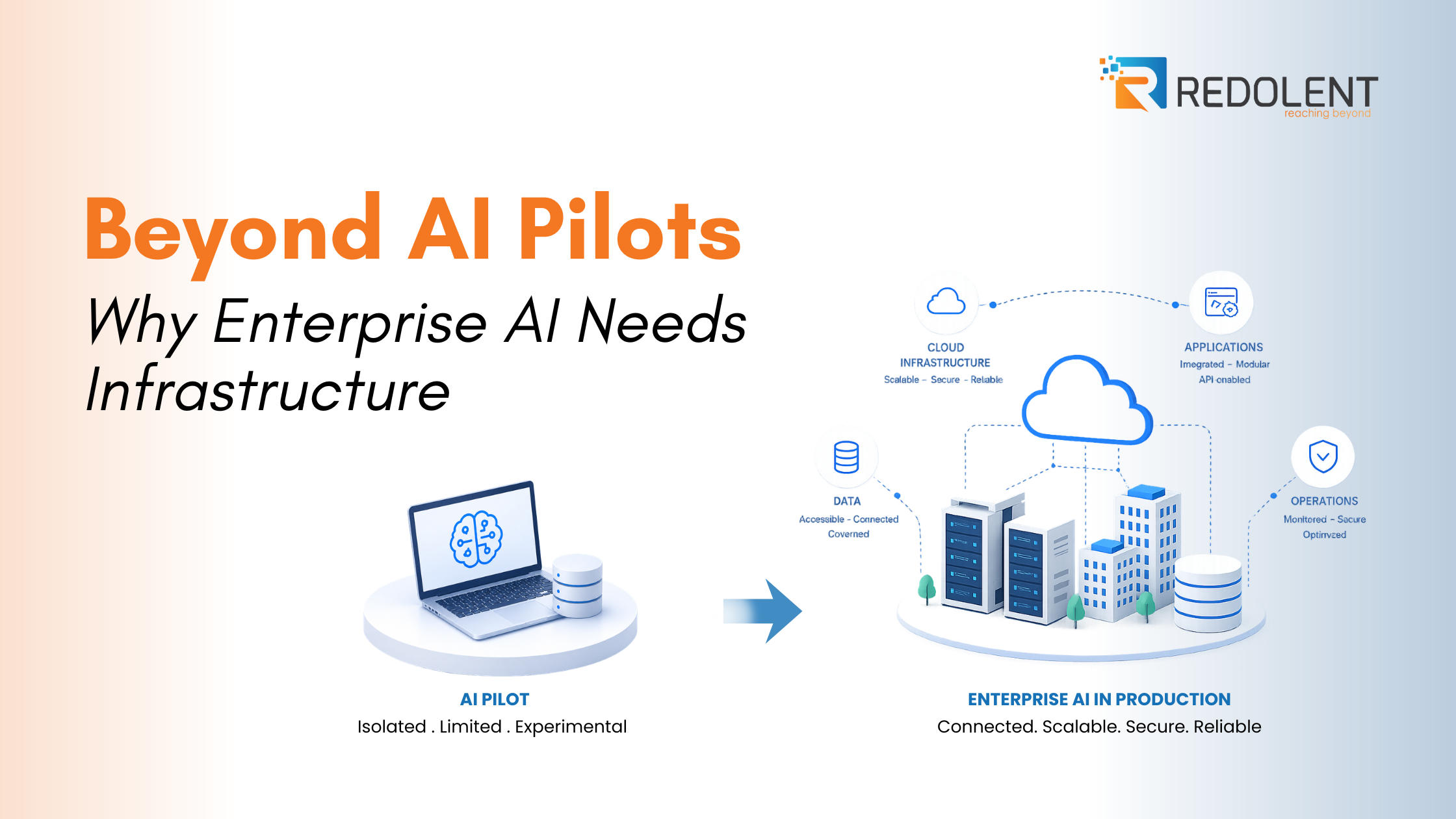
The Cost of Legacy Systems: Impact on Business Growth
April 9, 2026